
What Is Social Media Marketing? The Complete Guide for Small Business Owners in 2026
Your customers are spending hours every day on social media — scrolling, discovering, and buying from businesses they find there. Social Media Marketing is how your small business shows up in those moments and turns attention into loyal customers.
Social Media Marketing is the practice of using social media platforms — Facebook, Instagram, TikTok, LinkedIn, X, YouTube, and others — to promote your business, connect with your target audience, build your brand, and ultimately drive sales and growth. For small business owners in 2026, Social Media Marketing is no longer an optional extra that only big brands with large marketing budgets can afford to do well. It is one of the most powerful, accessible, and cost-effective ways to reach new customers, stay connected with existing ones, and build the kind of genuine brand relationships that turn first-time buyers into long-term loyal advocates.
The numbers tell a compelling story. There are over five billion active social media users worldwide in 2026. The average person spends more than two and a half hours on social media every single day. And crucially for small businesses, research consistently shows that people discover new businesses, research purchase decisions, and seek recommendations through social platforms more than through almost any other channel. If your business is not showing up meaningfully in those spaces, you are invisible during some of the most important moments in your potential customers’ decision-making journey.
But Social Media Marketing is a broad and sometimes confusing discipline. What does it actually involve? How does it work? What platforms should your small business be on? How does organic content differ from paid advertising? And what does genuinely effective social media marketing look like for a business like yours? This article answers all of those questions in plain, practical language — giving you the foundation you need to make smart decisions about social media marketing for your small business.
What Is Social Media Marketing? A Clear Simple Definition
At its core, Social Media Marketing is the use of social media platforms to achieve business goals. Those goals might include raising awareness of your brand among people who have never heard of you, driving traffic to your website, generating leads and enquiries, converting followers into paying customers, building a community around your products or services, or providing customer service that strengthens relationships and reduces churn.
What makes Social Media Marketing distinctive from other forms of marketing is the two-way nature of social platforms. Traditional marketing — a newspaper advertisement, a TV commercial, a billboard — broadcasts a message to a passive audience. Social media creates a conversation. Your audience can respond to your content, share it with their own networks, ask questions, leave reviews, and engage with your brand in ways that no other marketing channel enables. This interactivity is both the greatest opportunity and the greatest challenge of Social Media Marketing — it requires genuine engagement, not just broadcasting.
Social Media Marketing is not about shouting your message at as many people as possible. It is about showing up consistently in the places where your ideal customers already spend their time — and giving them a reason to stop, pay attention, and choose your business.
Social Media Marketing encompasses several distinct activities that work together to build your presence and drive results. These include creating and publishing organic content, running paid advertising campaigns, engaging with your audience through comments and messages, working with influencers and content creators, monitoring what is being said about your brand, and analyzing performance data to continuously improve your approach.
Social Media Marketing Platforms: Which Ones Matter for Small Businesses
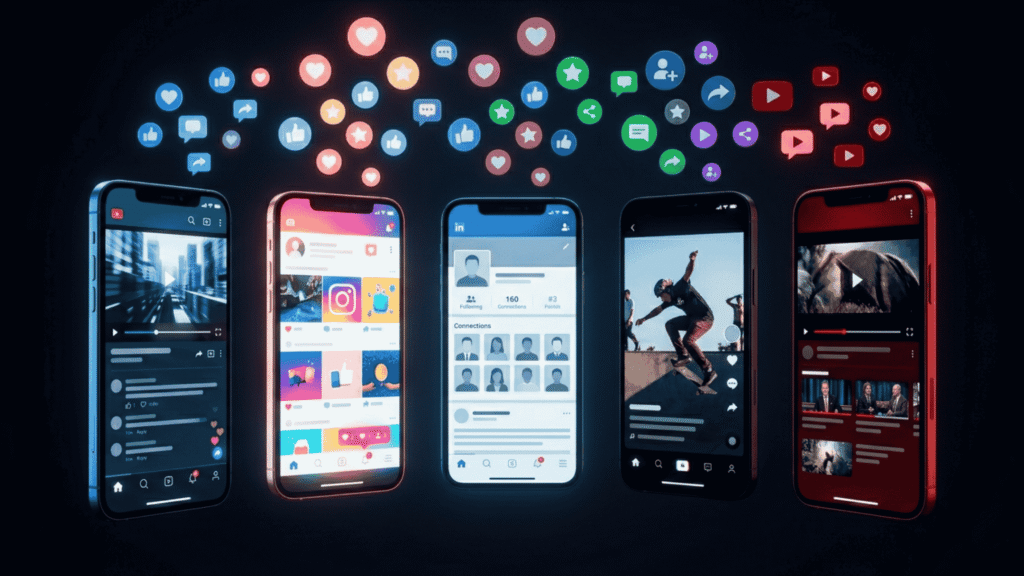
One of the first questions every small business owner asks about Social Media Marketing is: which platforms should I be on? The honest answer is that you do not need to be everywhere — you need to be on the platforms where your specific customers spend their time, and where the type of content your business can realistically create performs well. Here is a practical overview of the major platforms:
Facebook — The Broadest Reach
With nearly three billion active users, Facebook remains the largest social media platform in the world and is particularly strong for reaching adults aged 25 to 55 — a demographic that includes many small business customers. Facebook’s advertising platform is among the most sophisticated available, allowing you to target potential customers with extraordinary precision based on location, age, interests, behavior, and dozens of other variables. For local businesses, service businesses, and community-focused brands, Facebook remains one of the most valuable Social Media Marketing channels available.
Instagram — Visual Storytelling and Discovery
Instagram is a visually-driven platform built around photos, short videos, Stories, and Reels. It is particularly powerful for businesses whose products or services lend themselves to compelling visual content — food and hospitality, fashion and retail, beauty and wellness, home interiors, travel, and lifestyle brands of all kinds. Instagram’s shopping features allow customers to purchase directly from posts and Stories, making it one of the most commercially effective platforms for product-based businesses. Its younger demographic skews toward 18 to 34, making it essential for brands targeting that age group.
TikTok — Short Video and Rapid Discovery
TikTok has become one of the fastest-growing and most culturally influential social platforms in the world, driven by its extraordinarily powerful content discovery algorithm that can expose any video to millions of viewers regardless of the creator’s follower count. For small businesses willing to invest in short-form video content, TikTok offers organic reach potential that no other platform currently matches. Businesses that have found their voice on TikTok — authentic, entertaining, and genuinely useful — have achieved growth that would have been impossible through any other channel at the same cost.
LinkedIn — Professional and B2B Audiences
LinkedIn is the dominant professional social network and the most important Social Media Marketing platform for businesses selling to other businesses, professional service providers, recruiters, consultants, and anyone whose customers are working professionals. LinkedIn content reaches decision-makers in a professional mindset — making it the highest-quality lead generation platform for the right type of business, even if its audience is smaller than Facebook or Instagram.
YouTube — Long-Form Video and Search
YouTube is both a social platform and the world’s second-largest search engine, making it uniquely powerful for businesses that can create valuable video content. Tutorial videos, product demonstrations, behind-the-scenes content, and expert commentary all perform strongly on YouTube — attracting customers who are actively searching for information related to your products or services. YouTube content has exceptional longevity compared to other social platforms, with videos continuing to drive views and leads for months or years after publication.
Social Media Marketing: Organic vs Paid — What Is the Difference?
Understanding the distinction between organic and paid Social Media Marketing is essential for planning your strategy and your budget effectively:
Organic Social Media Marketing
Organic social media refers to all the content you publish on your social platforms without paying to promote it — your regular posts, Stories, Reels, videos, and responses to comments and messages. Organic content builds your brand presence, nurtures relationships with your existing audience, demonstrates your expertise and personality, and creates the authentic human connection that makes social media valuable for businesses.
The challenge with organic social media in 2026 is that the major platforms have significantly reduced the organic reach of business content over the past several years — meaning that even your most loyal followers may only see a fraction of what you post. Consistent, high-quality organic content is still essential, but relying on organic reach alone to grow your business audience is increasingly difficult.
Paid Social Media Marketing
Paid social media — social media advertising — allows you to pay to show your content to a precisely targeted audience beyond your existing followers. Facebook and Instagram ads, TikTok ads, LinkedIn sponsored content, and YouTube pre-roll advertising all allow you to define exactly who sees your content based on demographics, interests, location, behavior, and more. Paid social is the fastest way to grow your audience, generate leads, and drive direct sales — but it requires both financial investment and the expertise to create campaigns that actually convert rather than simply spend your budget.
The most effective Social Media Marketing strategies for small businesses combine both — using organic content to build genuine relationships and credibility with your existing audience, and using targeted paid advertising to reach new potential customers and drive specific business outcomes.
What Does Social Media Marketing Actually Involve Day to Day?
Many small business owners are surprised by the scope of work that effective Social Media Marketing requires. Here is what a genuinely effective Social Media Marketing operation looks like in practice:
Content Strategy and Planning
Effective Social Media Marketing begins with a clear content strategy — a plan for what you will publish, on which platforms, at what frequency, in what formats, and with what goals. A content strategy answers the questions: who are we talking to, what do they care about, what do we want them to think feel and do after encountering our content, and how does our social media presence reflect our brand identity. Without a content strategy, social media activity becomes random and produces random results.
Content Creation
Creating compelling social media content is one of the most time-intensive aspects of Social Media Marketing. It involves writing engaging captions, designing eye-catching graphics, shooting and editing photos and videos, creating Stories and Reels, and ensuring everything is formatted correctly for each platform’s specific requirements. High-quality content creation requires a combination of copywriting skill, visual design capability, and platform-specific knowledge — which is why many small businesses benefit from professional support rather than trying to handle everything in-house.
Community Management and Engagement
Social media is a two-way channel — and brands that post content but ignore comments, messages, and mentions are missing one of the most valuable aspects of the medium. Community management involves responding to comments and questions promptly, engaging genuinely with followers’ content, managing customer service enquiries that come through social channels, and building the kind of responsive, human presence that makes followers feel valued and heard. Consistent engagement is what transforms a social media account from a broadcasting channel into a genuine community.
Paid Campaign Management
Running effective paid social media advertising campaigns requires ongoing management — not just setting up ads and leaving them to run. Effective campaign management involves monitoring performance daily, testing different ad creatives and audiences, optimizing budgets based on what is working, adjusting targeting as you gather data about who is responding, and continuously improving your campaigns based on evidence rather than assumption. Poorly managed paid social campaigns waste budget without generating meaningful results — well-managed ones deliver a measurable, positive return on investment.
Analytics and Reporting
Understanding what is working and what is not is fundamental to improving your Social Media Marketing over time. Analytics involves tracking key metrics — reach, engagement rate, follower growth, website traffic from social, lead volume, conversion rate, cost per lead for paid campaigns — and drawing actionable conclusions from the data. Regular reporting keeps you informed about whether your social media investment is delivering business value and guides the strategic decisions that improve performance over time.
Social Media Marketing Benefits for Small Businesses
The right Social Media Marketing strategy delivers specific, measurable benefits that directly impact your small business’s growth and sustainability:
- Brand awareness at affordable cost: Social media allows small businesses to build genuine brand awareness among thousands of potential customers at a fraction of the cost of traditional advertising channels. A single piece of compelling content can reach far beyond your existing audience through shares, hashtags, and platform algorithms — delivering exposure that would cost significantly more through any other medium.
- Direct connection with your customers: No other marketing channel gives you the ability to have direct, real-time conversations with your customers at scale. Social media allows you to understand what your customers care about, respond to their feedback, celebrate their loyalty, and build the kind of genuine relationships that create lasting brand preference.
- Targeted reach to your ideal customer: Paid social advertising allows you to reach people who match your ideal customer profile with extraordinary precision — by location, by age and demographics, by interests and behaviors, and even by their relationship with competitors. For small businesses with limited marketing budgets, this targeting capability means you can ensure almost every pound you spend reaches someone with genuine potential to become your customer.
- Social proof and credibility: A well-maintained social media presence with an engaged following, positive comments, and authentic customer stories builds credibility that influences purchase decisions. When a potential customer discovers your business and finds an active, engaged social presence with happy customers sharing their experiences, their confidence in choosing you increases significantly.
- Website traffic and lead generation: Strategic Social Media Marketing drives qualified traffic to your website — visitors who already know something about your brand and are primed to take action. With the right calls to action and landing pages, social media becomes a consistent source of leads and enquiries for your business.
- Competitive intelligence: Social media gives you a window into your competitors’ marketing activity, their customer conversations, and the gaps in their offering that your business could fill. Monitoring your competitive landscape through social platforms is one of the most accessible forms of market research available to small businesses.

Common Social Media Marketing Mistakes Small Businesses Make
Understanding what not to do is as valuable as understanding what to do. Here are the most common Social Media Marketing mistakes that hold small businesses back:
- Trying to be on every platform at once: Spreading your effort thinly across six platforms produces mediocre results on all of them. It is far better to do two or three platforms exceptionally well than to maintain a half-hearted presence everywhere. Choose the platforms where your customers actually are and focus your energy there.
- Posting without a strategy: Random posts with no clear purpose, consistent brand voice, or connection to business goals generate activity without results. Every piece of content you publish should serve a defined purpose — whether that is building awareness, demonstrating expertise, driving traffic, or converting interest into action.
- Ignoring engagement: Posting content and never responding to comments or messages sends a clear signal that you are not genuinely interested in your audience. Engagement is not optional — it is the mechanism through which social media builds real relationships and genuine brand loyalty.
- Focusing on follower count over engagement quality: A small, highly engaged audience of genuine potential customers is far more valuable than a large audience of passive or irrelevant followers. Vanity metrics like follower count matter far less than the quality of the relationships you are building and the business outcomes your social presence is driving.
- Giving up too soon: Social Media Marketing is a long-term investment. Businesses that expect immediate dramatic results and give up after a few weeks of modest engagement never give the strategy time to compound and deliver its full value. Consistency over months and years is what builds a genuinely powerful social media presence.
How to Get Started With Social Media Marketing for Your Small Business
If you are new to Social Media Marketing or looking to significantly improve your current approach, here is a practical starting framework:
- Define Your Goals Clearly
Before you post a single piece of content, be clear about what you want Social Media Marketing to achieve for your business. More local awareness? More website enquiries? More online sales? Direct bookings? Each goal requires a different strategy, different content, and different metrics for measuring success. Clear goals are what separate purposeful Social Media Marketing from random activity.
- Know Your Audience Deeply
The most effective social media content is built on a thorough understanding of your target customer — what they care about, what problems they are trying to solve, what kind of content they enjoy engaging with, which platforms they use, and what would make them choose your business over a competitor. The more specifically you understand your audience, the more precisely you can create content that resonates with them.
- Choose Two or Three Platforms and Commit
Based on where your target customers spend time and what type of content your business can realistically create well, choose two or three platforms and commit to showing up consistently on them. It is far better to be excellent on Instagram and Facebook than mediocre on six platforms simultaneously.
- Create a Content Calendar
Plan your content at least two to four weeks in advance. A content calendar that maps out what you will post, on which platforms, on which days, in what format, and with what goal removes the daily stress of figuring out what to post and ensures your social presence is strategic and consistent rather than reactive and random. - Measure, Learn, and Improve
Review your performance data at least monthly. Which posts got the most engagement? Which drove the most website traffic or enquiries? Which fell flat? Use this data to do more of what is working, less of what is not, and continuously improve the quality and effectiveness of your Social Media Marketing over time.
Final Thoughts: Social Media Marketing Is One of the Best Investments a Small Business Can Make
Social Media Marketing has fundamentally changed the relationship between businesses and their customers — and for small businesses, it has created opportunities that simply did not exist a generation ago. The ability to build a genuine audience, tell your brand story, connect directly with customers, and compete for attention alongside businesses many times your size — all at a cost that fits a small business budget — is genuinely unprecedented in the history of marketing.
But the opportunity is only realized by businesses that approach Social Media Marketing with the clarity, consistency, and genuine commitment it requires. Random posting, sporadic effort, and impatience produce random and disappointing results. Strategic, consistent, audience-focused Social Media Marketing produces compounding returns that grow more valuable over time.
Whether you manage your social media in-house or work with a professional agency, the businesses that invest seriously in Social Media Marketing today are the ones building the brand recognition, customer relationships, and digital presence that will sustain their growth for years to come. In 2026, that investment is not optional for any small business that intends to compete and grow.
Visit our social media marketing :