
What Is Application Development? A Complete Guide for Small Business Owners in 2026
Every app on your phone, every booking system you use, every customer portal you log into — all of it was built through application development. Here is your plain-English guide to understanding what application development is and how it can transform your small business.
Application development is the process of designing, building, testing, and launching software applications — commonly known as apps — that run on mobile devices, desktop computers, or web browsers. Every digital tool your business and your customers use on a daily basis exists because a team of developers went through the application development process to bring it to life. The ride-hailing app on your phone, the online booking system your dentist uses, the inventory management software your supplier operates, the loyalty rewards app your favourite coffee shop offers — all of these are products of application development. And in 2026, application development has become one of the most powerful investments a small business can make to streamline operations, improve the customer experience, and create new revenue opportunities that simply would not be possible without custom software.
For most of the history of computing, custom application development was the exclusive domain of large corporations with substantial technology budgets and in-house development teams. That world has changed dramatically. Advances in development tools, the availability of skilled development professionals, and the maturity of platforms and frameworks that accelerate the building process have made custom application development accessible to small and medium businesses at price points that deliver genuine return on investment.
This guide explains exactly what application development involves, what the different types of applications are, how the development process works from idea to launch, what benefits a custom application can deliver for a small business, and how to make smart decisions when evaluating application development for your own business needs.
What Is Application Development? The Core Definition
Application development is the end-to-end process of creating software that solves a specific problem or serves a specific purpose for its users. It encompasses everything from the initial idea and requirements gathering through design, coding, testing, deployment, and ongoing maintenance after launch.
The term application — or app — refers to any piece of software designed to help users accomplish specific tasks. Applications range from the simplest single-purpose tools to extraordinarily complex systems that power entire business operations. What they all have in common is that they were built through a structured application development process that turned a human need or business requirement into a functioning piece of software.
Application development is distinct from web development, though the two disciplines overlap significantly. Web development focuses primarily on building websites and web-based experiences. Application development focuses on building functional software tools — whether those tools happen to run in a web browser, on a mobile device, on a desktop computer, or across all three simultaneously.
An application is not just a piece of software — it is a solution to a real problem. The best application development starts not with technology but with a deep understanding of the problem that needs solving and the people who need it solved.
Types of Application Development Every Small Business Should Understand
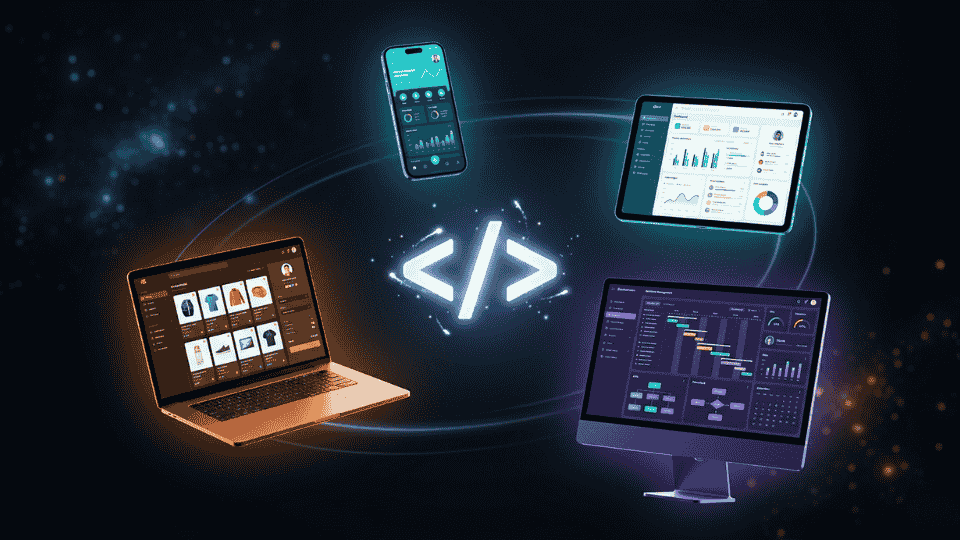
Application development covers several distinct categories, each suited to different business needs and user contexts. Understanding these categories helps you identify which type of application development is relevant to your specific situation:
Mobile Application Development
Mobile application development creates apps that run on smartphones and tablets — the devices your customers carry with them everywhere, every day. Mobile apps are built for two primary platforms: iOS, which powers Apple iPhones and iPads, and Android, which powers the majority of smartphones worldwide. A mobile app gives your business a permanent presence on your customers’ most personal and frequently used device — enabling direct communication through push notifications, frictionless transactions, loyalty programs, booking systems, and a level of customer engagement that no other channel can match.
Mobile apps can be built natively — developed specifically for iOS or Android using each platform’s dedicated tools and languages, delivering the best possible performance and user experience — or using cross-platform frameworks like React Native and Flutter that allow a single codebase to run on both platforms, reducing development time and cost while maintaining good performance.
Web Application Development
Web applications are software tools that run inside a web browser rather than being installed on a device. Unlike websites, which primarily present information, web applications are interactive tools that users engage with to accomplish tasks — think online banking portals, project management platforms, CRM systems, booking engines, and e-commerce dashboards. Web applications are accessible from any device with a browser and an internet connection, require no installation, and can be updated instantly without requiring users to download anything. For many small business use cases, a well-built web application delivers everything a native mobile app would at lower development cost and with broader accessibility.
Custom Business Application Development
Custom business applications are software tools built specifically to serve the internal operational needs of a particular business — rather than being sold to external customers. Custom inventory management systems, staff scheduling tools, customer relationship management platforms, reporting dashboards, workflow automation tools, and internal communication systems are all examples of custom business applications. When off-the-shelf software does not quite fit how your business operates — forcing you to work around its limitations rather than having it work for you — a custom application built to your exact requirements is often the most efficient long-term solution.
E-Commerce Application Development
E-commerce application development builds the software infrastructure that enables businesses to sell products and services online. This goes beyond a simple website with a shopping cart — sophisticated e-commerce applications manage inventory across multiple channels, handle complex pricing and discount logic, integrate with fulfilment and logistics systems, process payments securely, manage customer accounts and order history, and generate the analytics that help businesses understand and optimize their sales performance. For small businesses with ambitions to grow online sales, a professionally developed e-commerce application is one of the highest-return technology investments available.
API Development and Integration
APIs — Application Programming Interfaces — are the connective tissue of modern software. They allow different applications to communicate and share data with each other. API development creates these connection points, while API integration connects your existing business systems — your accounting software, your CRM, your e-commerce platform, your delivery provider — into a unified ecosystem where data flows automatically rather than being manually re-entered between systems. For small businesses running multiple software tools, API integration through application development eliminates the duplication, errors, and inefficiency of disconnected systems.
The Application Development Process: From Idea to Launch
Understanding how professional application development works helps you prepare for a development project, set realistic expectations, and evaluate the quality of the partners you work with. Here is what a well-managed application development process looks like:
Discovery and Requirements Definition
Every successful application development project begins with thorough discovery — a structured process of understanding what the application needs to do, who will use it, how they will use it, what problems it must solve, and what constraints exist around budget, timeline, and technical environment. This phase produces a clear requirements document that defines the scope of the project and serves as the reference point for all subsequent decisions. Skipping or rushing discovery is the single most common cause of application development projects that deliver the wrong thing — on time and on budget but failing to solve the actual problem.
Design and User Experience
Before any code is written, the user experience and visual design of the application should be thoroughly planned and validated. This involves creating wireframes — structural blueprints showing the layout and flow of every screen — and then visual mockups or interactive prototypes that represent exactly what the finished application will look and feel like. Good UX design in application development is not just about aesthetics — it is about ensuring that real users can accomplish their goals quickly, intuitively, and with minimal friction. An application that is technically functional but confusing or frustrating to use will not be adopted, regardless of how well it is built.
Development and Engineering
With requirements defined and design approved, development begins — the engineering work of turning designs into a functioning application. Professional application development follows established methodologies, typically working in short iterations called sprints that deliver working software incrementally rather than attempting to build everything at once before showing anything. This iterative approach surfaces problems early when they are cheap to fix, allows requirements to be refined based on what is learned as the application takes shape, and ensures that the final product closely matches what was actually needed rather than what was originally imagined.
Testing and Quality Assurance
Thorough testing is not an optional phase that gets compressed when schedules are tight — it is a fundamental part of professional application development that determines whether the finished product actually works reliably in the real world. Quality assurance testing covers functional testing to verify that every feature works as specified, performance testing to ensure the application performs adequately under realistic load, security testing to identify and remediate vulnerabilities, compatibility testing across the range of devices and browsers your users will employ, and user acceptance testing to confirm that real users can accomplish their goals effectively.
Deployment and Launch
Deploying an application to production — making it available to real users — is a carefully managed process that involves configuring servers and infrastructure, setting up monitoring and alerting systems, implementing backup and recovery procedures, and managing the transition from development to live operation. A professional application development team manages this process methodically, ensuring that the application launches smoothly and that any issues that emerge in the live environment are detected and addressed quickly.
Maintenance and Ongoing Development
Application development does not end at launch — it enters a new phase. Applications require ongoing maintenance to keep them secure and compatible with evolving operating systems and browsers, fix bugs that only emerge under real-world usage, and respond to changing user needs and business requirements. The most valuable applications evolve continuously after launch, incorporating user feedback, adding new features, and improving performance as the business grows and its needs develop. Planning for ongoing maintenance from the beginning — both in terms of budget and technical architecture — is one of the marks of mature application development practice.
Application Development Benefits for Small Businesses
Investing in custom application development delivers specific, tangible benefits that generic off-the-shelf software simply cannot match for businesses with unique needs or growth ambitions:
- Built precisely for your business: A custom application is designed around exactly how your business operates, your specific workflow, your particular customer journey, and your unique requirements. Unlike generic software that forces you to adapt your processes to fit its limitations, a custom application adapts to you — making your operations more efficient and your customer experience more coherent.
- Competitive differentiation: A custom application that solves a problem your competitors have not addressed, serves your customers in a way no generic tool enables, or automates a workflow that others handle manually gives your business a genuine competitive advantage that is very difficult to replicate. The best small business applications become strategic assets that support sustainable competitive differentiation.
- Scalability that grows with you: Custom applications are architected to scale with your business — handling more users, more transactions, and more data as your business grows, without requiring a disruptive platform change at the worst possible moment. Off-the-shelf solutions often impose limits that become expensive constraints as your business evolves.
- Integration with your existing systems: A custom application can be built to integrate seamlessly with the other software your business already uses — your accounting system, your CRM, your e-commerce platform, your logistics provider. This integration eliminates the manual data entry, duplication, and errors that plague businesses running disconnected systems.
- Full ownership and control: When you invest in custom application development, you own the software that is built. You are not subject to a vendor’s pricing decisions, feature roadmap, policy changes, or risk of discontinuation. Your application is a business asset you control entirely — and its value compounds as it becomes more deeply integrated into your operations.
- Enhanced customer experience: A well-designed custom application — whether a mobile app your customers download, a customer portal they log into, or a booking system they use — delivers a seamless, branded experience that generic tools cannot match. Every touchpoint your customers have with your business shapes their perception of your brand, and a polished custom application communicates professionalism and care for the customer experience.

Signs Your Small Business Needs Application Development
Many small business owners are not sure whether their business actually needs a custom application or whether existing tools would serve their needs adequately. Here are the most reliable indicators that application development would deliver meaningful value for your business:
- You are doing the same data entry in multiple systems: If your team regularly copies information from one software tool to another — re-entering customer details, order information, or operational data across disconnected systems — you are paying a significant hidden cost in time, errors, and inefficiency that custom application development and integration could eliminate.
- Your off-the-shelf software does not quite fit: If you regularly work around the limitations of your current software — using it in ways it was not designed for, maintaining spreadsheets alongside it to fill gaps, or accepting operational compromises because the software does not support how you actually work — a custom application built to your exact requirements would likely pay for itself through efficiency gains alone.
- You have a customer experience gap that technology could close: If there is something your customers regularly ask for — a booking system, a loyalty program, a self-service portal, a real-time order tracking feature — that you cannot currently offer because no affordable off-the-shelf solution fits your specific context, a custom application could close that gap and meaningfully improve customer satisfaction and retention.
- You have a process that could be automated but currently is not: If your team regularly performs manual, repetitive tasks that follow predictable rules — generating reports, sending routine communications, processing standard requests, moving information between systems — these are candidates for automation through application development that frees your team for higher-value work.
- You want to offer a digital product or service: If your business model includes or could include a digital product — a subscription service, a mobile app your customers pay for, a platform that connects buyers and sellers — application development is the foundational capability that makes that product possible.
How to Choose the Right Application Development Partner
Selecting the right application development partner is one of the most consequential decisions involved in a development project. Here is what to look for:
Relevant Experience and Portfolio
Look for an application development partner with demonstrable experience building applications similar in scope and type to what you need — similar platforms, similar complexity, similar industry if possible. A strong portfolio of completed projects with evidence of successful outcomes — not just attractive screenshots but actual results delivered for real clients — is the most reliable indicator of what you will receive.
Clear Communication and Structured Process
Application development projects succeed or fail largely on the quality of communication and process management. Evaluate potential partners on how clearly they communicate, how thoroughly they explain their process, how well they listen to and document requirements, and how transparently they handle scope, timeline, and budget. A partner who cannot communicate clearly during the sales process will not communicate clearly during the project.
Technical Expertise and Modern Practices
Ensure your application development partner uses modern development practices — version control, automated testing, code review, security best practices, and scalable architecture patterns. Ask about their testing approach, their deployment process, and how they handle ongoing maintenance. Technical shortcuts taken during development become expensive problems after launch.
Honest Scoping and Realistic Timelines
Be wary of partners who tell you exactly what you want to hear about timeline and budget without asking enough questions to justify those estimates. Honest application development scoping requires thorough requirements discovery — and any partner who produces a confident fixed-price quote without that process either has much more experience with your exact type of project than is typical, or is setting you up for a difficult conversation later about scope changes and additional costs Final Thoughts: Application Development Is How Small Businesses Build Their Digital Future
Application development has crossed the threshold from enterprise-only technology investment to a genuinely accessible and commercially viable option for small businesses with the right needs and the right problems to solve. The businesses that are investing in custom application development today are not doing so because it is fashionable — they are doing so because it delivers competitive advantages, operational efficiencies, and customer experiences that no generic off-the-shelf software can replicate.
Whether you need a mobile app that puts your business in your customers’ pockets, a custom internal tool that automates a costly manual process, an e-commerce platform that scales with your growth ambitions, or an integration that connects your business systems into a seamless whole — professional application development is how you build the digital infrastructure that your business needs to compete and grow in 2026 and beyond.
The best application development investment a small business can make is one that solves a real problem, serves real users, and delivers measurable business value. Finding the right partner to help you define that problem clearly and build the right solution is the most important step on that journey — and it starts with understanding exactly what application development is and what it can do for a business like yours.